Explosions heard all over Iran as US strikes ...... Welcome to Glintnews......
N30 Billion to Win a Primary? EFCC Chairman Raises Alarm Over Rising Cost of Nigerian Politics
June 11, 2026
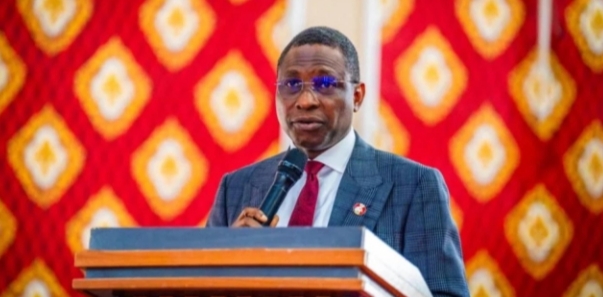
The Chairman of the Economic and Financial Crimes Commission (EFCC), Ola Olukoyede, has sounded a grave warning over the increasing monetisation of Nigeria’s electoral process, revealing that some governorship aspirants allegedly spend as much as N20 billion to N30 billion in their quest to secure electoral victories.
Olukoyede described the development as a dangerous trend capable of undermining democracy, encouraging corruption in public office, and weakening public trust in governance.
The EFCC chairman made the disclosure on Wednesday while delivering the inaugural High-Level Guest Speakers’ Series organised by the Centre for Peace and Strategic Studies (CPSS) at the University of Ilorin, Kwara State.
Speaking on the theme, “De-risking and Mobilising Critical Stakeholders for Peaceful and Credible 2027 Elections in Nigeria,” Olukoyede expressed concern over the growing influence of money in Nigeria’s political system, warning that elections were increasingly becoming contests of financial strength rather than platforms for presenting ideas and leadership capacity.
According to him, the enormous financial burden associated with contesting elections creates pressure on successful candidates to recover their investments after assuming office, often at the expense of public resources and good governance.
He noted that the commercialisation of politics has distorted the democratic process by compromising the quality of political recruitment and limiting opportunities for competent individuals who lack access to vast financial resources.
“The commercialisation of votes weakens the foundation of good governance because it compromises the political recruitment process,” Olukoyede said.
He further stressed that politicians who spend billions of naira to secure party tickets and win elections may be more inclined to focus on recouping their expenditures rather than delivering quality governance and development to the people.
The anti-graft agency boss warned that if the trend continues unchecked, it could further entrench corruption, fuel public distrust in democratic institutions, and threaten the long-term stability of Nigeria’s political system.
As part of efforts to safeguard the integrity of future elections, Olukoyede disclosed that the EFCC is preparing to deploy advanced technological tools, including drones and other surveillance systems, to monitor electoral activities ahead of the 2027 general elections.
According to him, the agency intends to strengthen its capacity to detect and prevent vote-buying, financial inducement, and other forms of electoral malpractice that could compromise the credibility of the polls.
He maintained that there should be no sacred cows in the enforcement of electoral laws, insisting that individuals and groups found engaging in vote-buying or other corrupt electoral practices would be investigated and prosecuted regardless of their political status.
Olukoyede also called on political parties, candidates, and their supporters to embrace issue-based campaigns and avoid divisive rhetoric capable of inciting violence before, during, and after elections.
He urged critical stakeholders, including the Independent National Electoral Commission (INEC), security agencies, civil society organisations, traditional institutions, the media, and political actors, to work collectively toward ensuring peaceful, transparent, and credible elections in 2027.
The EFCC chairman emphasised that credible elections remain the cornerstone of democratic development and national progress, adding that protecting the electoral process is a shared responsibility that requires vigilance from all sectors of society.
Earlier in his remarks, the Vice-Chancellor of the University of Ilorin, Professor Wahab Egbewole (SAN), described electoral corruption as one of the most serious threats confronting Nigeria’s democracy and national security.
Egbewole noted that when elections are manipulated through financial inducement and other corrupt practices, public confidence in government institutions diminishes, creating conditions that could undermine national stability and economic development.
He stressed the need for stronger collaboration between academic institutions, government agencies, and civil society groups in promoting electoral integrity and democratic values across the country.
Also speaking at the event, the Director of the Centre for Peace and Strategic Studies, Professor G.A. Animasawun, explained that the lecture series was established to encourage proactive discussions on emerging threats to Nigeria’s electoral process ahead of the 2027 elections.
According to him, the initiative will serve as a platform for policymakers, security experts, electoral officials, civil society organisations, scholars, and development partners to exchange ideas and develop practical strategies for strengthening democracy and preventing electoral violence.
The event attracted representatives of security agencies, electoral bodies, civil society organisations, members of the academic community, students, and other stakeholders committed to advancing peaceful and credible elections in Nigeria
.
With concerns already mounting over preparations for the 2027 general elections, Olukoyede’s revelation that some governorship aspirants allegedly spend up to N30 billion to secure political victories has reignited debate about the growing influence of money in Nigerian politics and the urgent need for reforms to protect the country's democratic future
We keep you informed and involved with anything from breaking news to thought-provoking opinion articles.