Explosions heard all over Iran as US strikes ...... Welcome to Glintnews......
Nigerian Government Arraigns Over 400 Terrorism Suspects In Abuja As Crackdown Intensifies After 386 Convictions In Previous Mass Trial
June 15, 2027
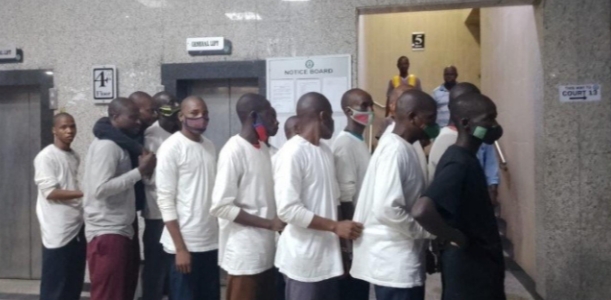
In a significant escalation of Nigeria's ongoing war against terrorism, the Federal Government has arraigned more than 400 suspected terrorists before various courts at the Federal High Court complex in Abuja, marking one of the country's largest coordinated terrorism prosecution exercises in recent years.
The suspects are facing multiple charges, including terrorism, aiding and abetting insurgent activities, conspiracy, and terrorism financing, as authorities intensify efforts to dismantle networks responsible for violent extremism and insecurity across the country.
The prosecution is being spearheaded by the Attorney General of the Federation (AGF) and Minister of Justice, Prince Lateef Olasunkanmi Fagbemi (SAN), alongside a team of federal prosecutors dedicated to handling terrorism-related cases. Also playing a central role in the proceedings is the Director of Public Prosecution of the Federation, Rotimi Oyedepo (SAN), who is part of the legal team representing the Federal Government.
The fresh arraignment underscores the government's determination to strengthen its legal offensive against terrorism and insurgency, particularly against individuals accused of supporting armed groups through logistics, recruitment, intelligence gathering, and financial assistance.
The latest mass trial comes only months after a similar exercise conducted in April 2026, during which the Federal Government prosecuted 508 terrorism suspects and secured hundreds of convictions. According to official records, 386 defendants were convicted on various terrorism-related offences, while eight were discharged after prosecutors failed to establish sufficient evidence against them and two others were acquitted by the courts. Several of those convicted received prison sentences of up to 20 years, depending on the severity of their offences.
To facilitate the speedy handling of the large number of cases, the Chief Judge of the Federal High Court, Justice John Tsoho, constituted a special panel of judges tasked with hearing and determining the terrorism-related matters. The move is aimed at ensuring the cases are treated with urgency while preserving the rights of the accused to a fair and transparent judicial process.
Unlike previous mass terrorism trials, which were conducted at a military facility in Kainji, Niger State, the current proceedings are taking place at the Federal High Court complex in Abuja. The relocation is seen as a significant shift towards a more open and civilian-led judicial process, allowing for greater transparency and easier access for legal representatives.
While the Office of the Attorney General is representing the Federal Government in the prosecutions, legal representation for defendants who cannot afford lawyers is being provided by the Legal Aid Council of Nigeria. This arrangement is intended to protect the constitutional rights of all accused persons and ensure that every defendant receives adequate legal representation regardless of financial status.
Nigeria has battled terrorism and insurgency for more than a decade, particularly in the North-East, where extremist groups have been responsible for thousands of deaths, mass displacement, kidnappings, and the destruction of communities. Security concerns have also expanded beyond direct attacks, with authorities increasingly focusing on terrorist financing networks, arms trafficking, and individuals accused of providing logistical support to insurgent groups.
The latest prosecutions represent one of the Federal Government's most extensive judicial offensives against terrorism and are expected to play a crucial role in weakening the networks that sustain insurgent activities across the country.
As the trials continue, Nigerians will be closely watching the proceedings, with many hoping the exercise will not only deliver justice but also strengthen national security, reinforce the rule of law, and contribute to lasting peace across affected regions.
With more than 400 suspects now standing trial and hundreds already convicted earlier this year, Nigeria's legal battle against terrorism appears to be entering a new and more aggressive phase.
We keep you informed and involved with anything from breaking news to thought-provoking opinion articles.