Explosions heard all over Iran as US strikes ...... Welcome to Glintnews......
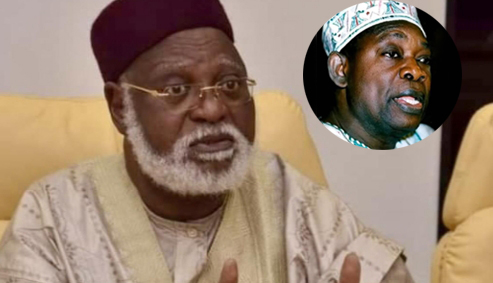
Abdulsalami Breaks Silence: Abiola Was Never Meant To Be Sworn In Immediately After June 12 Victory, Reveals Shocking Details About His Final Hours
June 15, 2026
Former Nigerian Head of State, General Abdulsalami Abubakar (retd.), has revealed that Chief Moshood Kashimawo Olawale (MKO) Abiola was never on the verge of being sworn in as President despite mounting pressure following the annulled June 12, 1993 presidential election.
In his newly released memoir, Abdulsalami also provided a chilling account of Abiola's final moments in detention, describing the day he received news of the business mogul's sudden death as one of the most devastating experiences of his life.
The former military ruler recounted the events surrounding a crucial meeting between Abiola and a high-profile American delegation, saying the visitors had specifically travelled to Nigeria to meet the detained politician but were initially denied access.
According to Abdulsalami, he was surprised to discover that the request had been blocked.
"They complained that they requested to see Abiola but were denied access to him. Meeting with Abiola was a major reason for their visit to Nigeria in the first place," he said.
Determined to resolve the issue, Abdulsalami immediately instructed his Chief Security Officer, Abdulrasheed Aliyu, to facilitate the meeting.
"I immediately called my CSO, Abdulrasheed Aliyu, and instructed him to arrange for them to see Abiola," he stated.
However, what was expected to be a routine diplomatic engagement soon turned into a national tragedy.
Abdulsalami recalled receiving an unexpected phone call from his security chief informing him that something had gone terribly wrong.
"Aliyu, my CSO, called me. As soon as I picked, he said, in a shaky voice, that there was a problem. I asked, 'What problem again?' He said Abiola was dead. My head went blank," he revealed.
He explained that Abiola suddenly became ill during the meeting.
"He said Abiola suddenly became restless and started coughing and sweating during the meeting and later died at the State House Clinic."
The former Head of State said the incident left him devastated and fearful that Nigeria's fragile peace process could collapse.
"I started thinking of many things at the same time. This was the most unexpected turn of events. The peace we were building was still so fragile and now this happened. We did not bargain for this."
"We were making progress trying to resolve the political crisis and this was going to be a spanner in the works. I wished it was a dream. I was devastated."

Abdulsalami said he immediately informed his deputy at the time, Vice Admiral Mike Akhigbe, as well as the then Secretary to the Government of the Federation, Alhaji Gidado Idris, before reaching out to Abiola's family members.
He described the moment he broke the news to the family as extremely painful.
"It was tough breaking the news to the family," he wrote.
"When I did, one of his daughters started crying profusely and was shaking uncontrollably. I held her and placed her head over my shoulders. She was inconsolable."
He also revealed that former United States diplomat Susan Rice stepped in to comfort the grieving family member.
"Rice said to me that she wanted to help. She took over, held the lady and consoled her."
Addressing the long-standing controversies surrounding Abiola's death, Abdulsalami argued that granting the American delegation access to him helped eliminate any suspicion that the government had concealed his death.
"If we had not allowed the American delegation to see him and he had died in custody, it would have been a different story. It would have been insinuated that he had long died and we were trying to cover it up," he said.
Despite this, he acknowledged that conspiracy theories persisted over the years.
The former military leader dismissed allegations that Abiola was poisoned, insisting there was no truth to such claims.
He also rejected widespread theories suggesting powerful forces orchestrated the deaths of both General Sani Abacha and MKO Abiola to end Nigeria's prolonged political crisis.
"It was also alleged that after they had taken Abacha out and NADECO insisted on Abiola being released and inaugurated as President, the supposed interests decided to take out Abiola a month later to balance the equation."
"Whoever came up with this theory was being uncharitable to both Abiola and the Federal Government," he added.
MKO Abiola, widely regarded as the winner of the June 12, 1993 presidential election, died on July 7, 1998, while in government custody, just one month after the sudden death of General Sani Abacha.
His death sparked widespread protests and unrest, especially in Lagos and other parts of southwestern Nigeria, with many Nigerians refusing to accept official explanations surrounding the circumstances of his demise.
Nearly three decades later, the circumstances surrounding Abiola's death remain one of the most controversial chapters in Nigeria's political history, continuing to fuel debates, conspiracy theories and demands for full historical accountability.
We keep you informed and involved with anything from breaking news to thought-provoking opinion articles.